
HOW TO control substrate addition in ROSITA 2.0 using soft sensors and equation-based control in ROSITA 2.0
To optimise microbial growth and product formation, feeding strategies must adapt to the culture’s actual needs. But many key variables, like growth rate or biomass, can’t be measured directly in real time. With ROSITA 2.0, you can calculate these values through soft-sensors and use them in equation-based control to automate feed rate adjustments based on […]
HOW TO automate different substrates and/or different feeding strategies in fed-batch applications using ROSITA 2.0
In fed-batch fermentations, it’s common to add different substrates at different times, each with its own purpose and ideal flow profile. But handling this manually often leads to inconsistency, mistimed additions, and irreproducible results. With ROSITA 2.0, you can combine feeding tools (constant, lineal, exponential) with the profile programming tool to automate the addition of […]
HOW TO adjust air–oxygen mixtures dynamically in ROSITA 2.0 according to culture evolution
Oxygen needs don’t stay static during fermentation. As biomass accumulates and metabolism shifts, the ideal air/O₂ mixture evolves, and matching it precisely can make the difference between a good batch and a “golden” one. With ROSITA 2.0 Profile Programming, combined with dissolved oxygen cascade and direct MFC programming, you can automate air–oxygen adjustments over time, […]
HOW TO replicate large-scale cooling in lab-scale E. coli fermentations using ROSITA 2.0
During downscaling activities, reproducing real industrial conditions is key to improving predictability and performance. One of the most critical variables is temperature, particularly how it decreases during later fermentation stages. In this step-by-step guide, we show how the ROSITA Profile Programming tool enables time-based temperature control that mimics large-scale cooling curves. This reduces “noise” during […]
HOW TO automate Temperature Profiles for biomass formation and recombinant protein expression in ROSITA 2.0
For the controlled production of biomass and recombinant proteins, temperature is a key process parameter that influences cell growth, induction, and product quality. However, adapting the temperature to each fermentation stage manually brings a risk of variability and an inconsistent process. With this in mind, we’ve developed a step-by-step guide to show how the ROSITA […]
The New Configurable and Expandable Gas Module of our F0-BABY and F1 Benchtop Bioreactors will Unlock the Potential of your Bioprocess
Deciding the configuration of your bioreactor can be a challenging process, especially when looking for a benchtop system to take the first steps at this scale. For that reason, configurability and expandability are the main factors to consider in this situation, so the optimization of your process does not get compromised due to a rigid […]
How to Use the Bionet Gas Module on an F0/f1 Optimally for my Process?
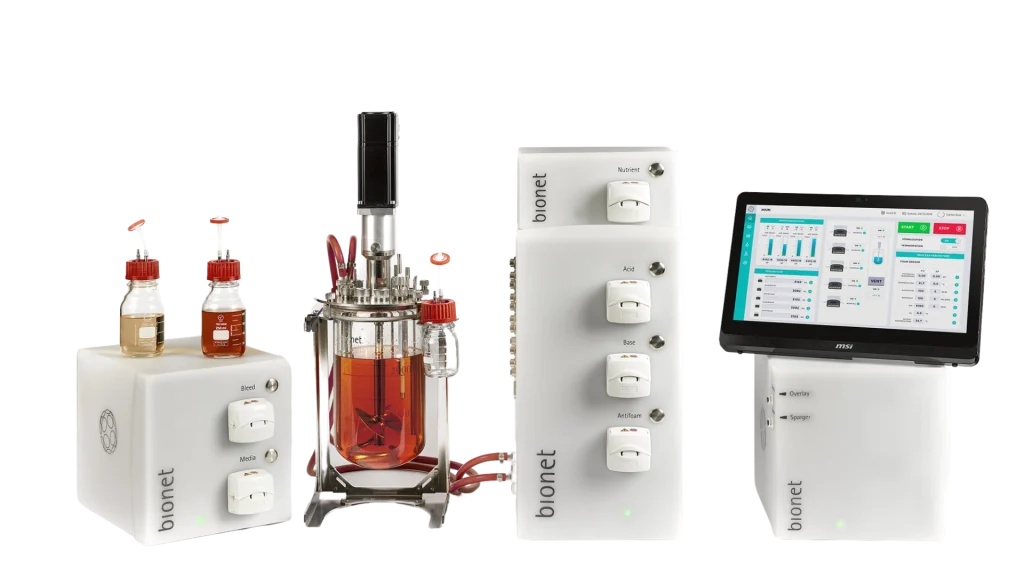
For the controlled production of microorganisms or living systems, gasification needs are always a critical part of the process regardless of its phase and its configuration can be challenging.Versatility and reliability are essential, on the one hand to find the conditions that optimize the process and on the other hand to reproduce the conditions entered […]
Production in Semi-continuous mode with the Yeast Pichia pastoris using BIONET’s F1 Bioreactor
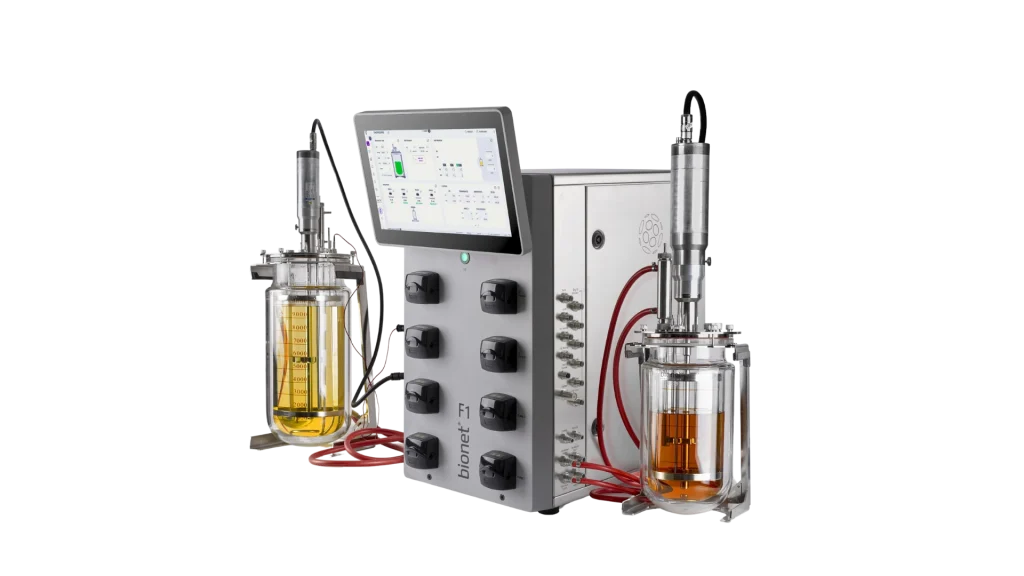
The yeast Pichia pastoris, has been successfully used as an efficient system to produce heterologous proteins [1]. Herein, we report the development of a semi-continuous process to improve the production of recombinant proteins in P. pastoris in BIONET’s F1 bench-top 3-liter bioreactor, equipped with a continuous process module (CPM). Six repetitive batches were conducted in […]
Scale-up of A Bioprocess Forbio-polymers Productionusing Animal by-products.

The production model of circular economy is becoming a focus of attention in our society. One of the solutions proposed by this model is waste revalorization. Most of the waste revalorization processes are based in the biotransformation of these waste materials into new valuable ones. In previous works, a fermentation process that aimed to use […]
