
Process development rarely depends on a single experiment. Whether optimising media, evaluating strains, comparing feeding strategies, or performing Design of Experiments studies, researchers often need to test multiple conditions before making decisions.
Parallel experimentation helps generate more information in less time and allows conditions to be compared under identical circumstances. As projects become more demanding, laboratories naturally increase the number of bioreactors available for process development.
Why Laboratories Choose Rosita 2.0 Multibioreactor
- Increase Experimental Throughput
Monitor, control, and collect data from up to 24 bioreactors within a single software environment. - Maintain Consistency Across Studies
Apply the same workflows, recipes, and operating procedures across every connected bioreactor. - Improve Operator Efficiency
Enable a single user to oversee multiple parallel experiments, reducing manual effort and simplifying process management.
However, increasing capacity introduces another challenge. More reactors mean more recipes, more batches, more users, and more information to coordinate. Eventually, managing experiments can become as demanding as running them.
The multibioreactor concept addresses both aspects. It enables higher throughput while bringing individual systems together into a common environment, ensuring consistency and facilitating collaboration across projects.
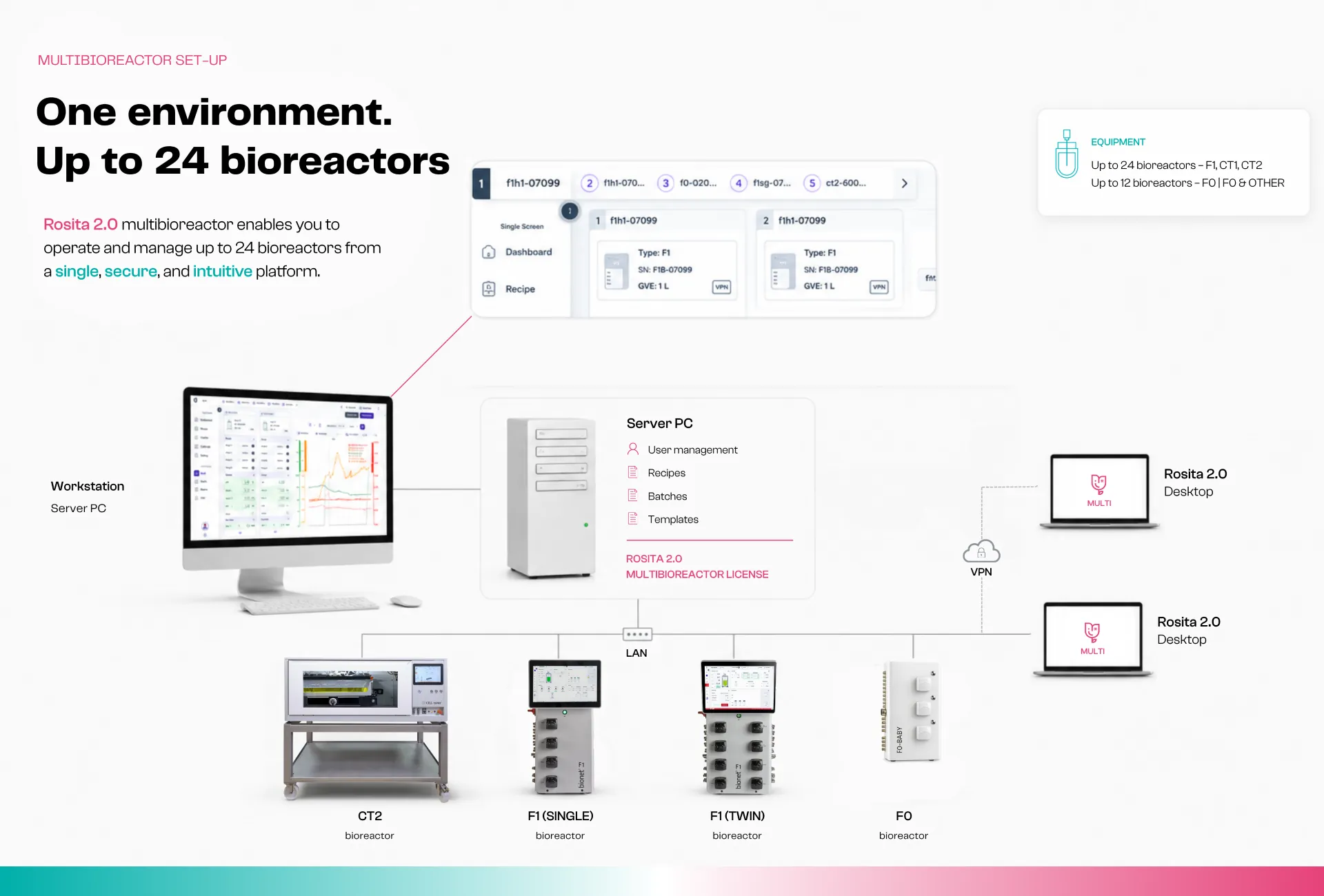
Rosita 2.0 provides the digital layer behind this concept. Through a central server architecture, up to 24* Bionet bioreactors can operate within the same environment, with recipes, templates, batch information, and user permissions managed centrally. Multiple users can access experiments from different workstations while working within standardised workflows, making collaboration easier and ensuring consistency across studies.
This approach is particularly valuable for strain screening, media selection, process optimization, and other data-intensive studies, where several conditions must be evaluated and compared under reproducible conditions. By generating structured and standardised datasets, the multibioreactor environment also provides a strong foundation for advanced analysis and future AI-driven workflows. As laboratories grow, maintaining organisation and standardisation becomes just as important as increasing throughput itself.
Rosita 2.0 Multibioreactor transforms individual bioreactors into a scalable process development ecosystem, helping laboratories increase throughput while maintaining reproducibility, collaboration, and control.
Looking to expand your process development capabilities? Discover how the Rosita 2.0 can help you advance your experiments
